
The Patient Living Situation section at Start of Care often feels straightforward.
House or apartment.
Alone or with someone.
Single story or stairs.
Many nurses move through it quickly.
But this section quietly shapes safety assessment, functional scoring, homebound status, care planning, and audit defensibility. When it’s rushed or oversimplified, the rest of the SOC can lose context.
This section isn’t about real estate — it’s about risk, access, and how the environment affects care.
What the Patient Living Situation Section Is Actually Measuring
This section is not asking:
- What type of home the patient owns
- How nice the home is
- Whether the home looks “fine”
It is asking:
Where does the patient live, who shares the space, and how does the environment affect safety, function, and care delivery?
CMS is looking for:
- Environmental barriers
- Safety risks
- Layout challenges
- Access issues
- How the home setup interacts with the patient’s condition
Living situation provides the context for everything else you document.
Common Pitfall #1: Treating Living Situation as a One-Line Answer
A frequent mistake is documenting something like:
- “Lives in single-family home with spouse”
- “Apartment, lives alone”
That’s technically accurate — but clinically incomplete.
Two patients can both “live in a single-family home” and have completely different risk profiles depending on:
- Stairs
- Clutter
- Lighting
- Bathroom access
- Bedroom location
- Mobility requirements
CMS is not interested in labels.
They’re interested in impact.
Why Living Situation Matters for Safety Assessment
The living environment directly affects:
- Fall risk
- Ability to evacuate
- Medication safety
- Wound care feasibility
- Equipment placement
- Caregiver access
Examples:
- Bedroom upstairs with limited mobility
- Narrow hallways limiting walker use
- Bathroom without grab bars
- Poor lighting increasing fall risk
- Clutter interfering with safe ambulation
These details help explain why the patient is at risk — not just that they are.
Living Situation and Functional Scoring Must Make Sense Together
Surveyors look for internal consistency.
If you document:
- Patient lives alone in a cluttered home with stairs
but score - Minimal functional limitations
That disconnect raises questions.
Conversely, documenting environmental barriers helps support:
- Transfer limitations
- Ambulation assistance
- ADL dependence
- Skilled need
The home environment is often the missing link that explains functional scores.
Living Situation and Homebound Status
The living situation section often supports homebound justification — even when patients technically have assistance.
Examples:
- Patient lives alone and requires assistance to navigate stairs
- Patient requires supervision to leave safely due to environmental hazards
- Patient’s home setup makes leaving the home a taxing effort
- Limited caregiver availability combined with environmental barriers
Homebound status is not just about diagnosis — it’s about what it takes to leave the home safely.
The living environment matters.
Common Pitfall #2: Ignoring Shared Living Spaces
Another issue is failing to clarify who else lives in the home and how that affects care.
Important considerations:
- Does the patient share a bedroom?
- Are there pets that interfere with equipment or wound care?
- Is the home overcrowded?
- Are caregivers present but not helpful?
- Are there safety concerns related to other household members?
Simply stating “lives with family” doesn’t tell the whole story.
Environmental Safety Is Not the Same as Cleanliness
A clean home can still be unsafe.
A cluttered home can sometimes be functional.
Focus your assessment on:
- Pathways for ambulation
- Access to bathroom and bedroom
- Safe medication storage
- Ability to perform wound care
- Space for durable medical equipment
Avoid judgmental language.
Stick to functional impact.
Documentation Tips That Protect You
When documenting patient living situation:
- Describe layout, not just location
- Note barriers and facilitators
- Connect environment to safety and function
- Avoid vague phrases like “home appropriate”
Examples of defensible documentation:
- “Patient resides in two-story home; bedroom located upstairs requiring stair negotiation multiple times daily.”
- “Narrow hallways limit safe walker use; patient observed furniture walking.”
- “Bathroom lacks grab bars; patient requires supervision for shower transfers.”
Specific documentation strengthens your SOC narrative.
Why Surveyors Care About This Section
The patient living situation helps CMS understand:
- Whether care is reasonable and necessary
- Whether risks were identified
- Whether the plan of care fits the environment
- Whether safety concerns were addressed
If the environment is complex but undocumented, it looks like it was missed.
Final Takeaway
The Patient Living Situation section is not a formality.
It sets the stage for:
- Functional scoring
- Homebound justification
- Safety planning
- Skilled need
- Care coordination
When documented thoughtfully, it explains why the patient needs home health — not just that they were referred.
A strong SOC tells a story that makes sense from start to finish.
The living situation is often the opening chapter.
Want a Step-by-Step SOC Guide?
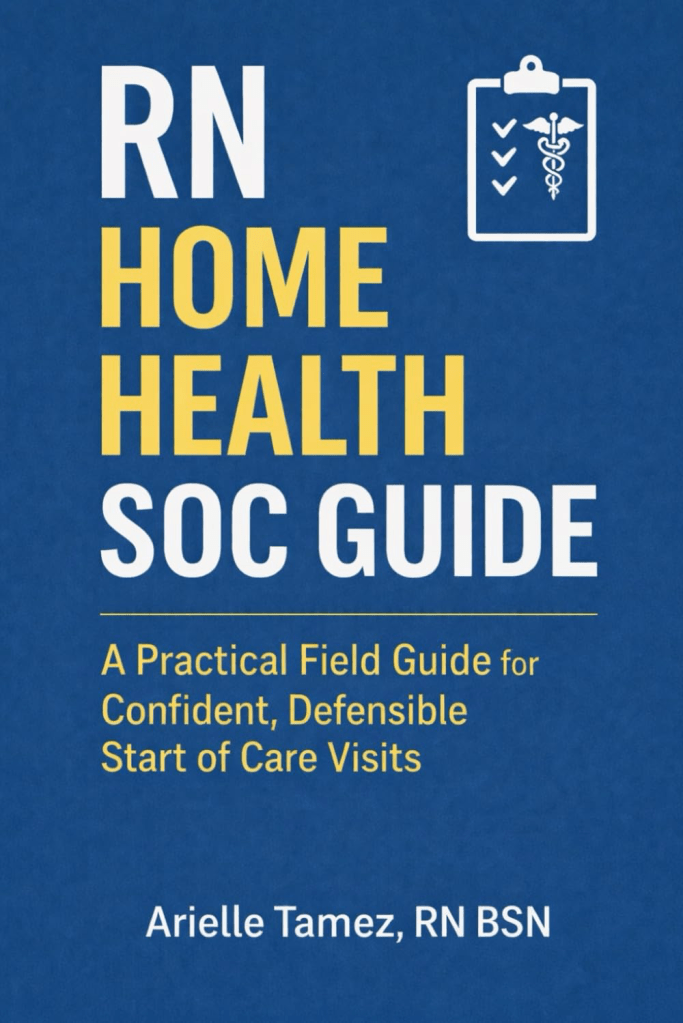
If you want deeper, item-by-item guidance for Start of Care — including how sections like M1100 Patient Living Situation connect to homebound status, functional scoring, and skilled need — my book breaks this down in a clear, practical way.
OASIS SOC Made Simple: A Practical Field Guide for Home Health Nurses
walks through Start of Care the way it actually happens in the home, with real-world explanations, documentation logic, and survey-aware guidance.
It’s designed for nurses who want their SOCs to:
- Make sense from start to finish
- Hold up under review
- Reflect what they actually assessed in the home
You can find the book on Amazon here:
👉 RN Home Health SOC Guide: A Practical Field Guide for Confident, Defensible Start of Care Visits
 RNonWheels
Leave a comment