
If you work in home health long enough, you will see eschar — especially on heels, toes, and feet. And eschar is one of those wound findings where doing too much can be far more dangerous than doing nothing.
This is why understanding eschar matters so much in the home setting.
What Is Eschar?
Eschar is dead tissue that forms after poor blood flow, pressure, or prolonged ischemia. It usually appears black or dark brown, is dry, thick, and often feels hard or leathery.
This is not the same thing as slough — and it’s definitely not a scab.
- Scab: dried blood over living tissue
- Slough: soft, moist non-viable tissue
- Eschar: dry, hard dead tissue
That distinction matters because eschar changes the entire plan of care.
Why Eschar Is Different in Home Health
In hospitals, wounds are often evaluated quickly by specialists.
In home health:
- Nurses are often the only ones seeing the wound
- Orders may be vague or outdated
- Perfusion status isn’t always clear
- The wrong intervention can cause rapid deterioration
Eschar requires restraint, not aggression.
Stable vs. Unstable Eschar (Critical Concept)
Stable eschar
Stable eschar is:
- Dry
- Hard
- Firmly attached
- No drainage
- No redness, warmth, odor, or swelling
The classic example is a dry black heel eschar.
👉 Stable eschar should NOT be removed.
It acts like a natural biological cover, protecting the tissue underneath. Removing it — especially in patients with poor circulation — can expose bone, introduce infection, and create a non-healing wound.
Unstable eschar
Eschar becomes unstable when it shows signs of breakdown or infection:
- Softening or bogginess
- Drainage or odor
- Surrounding erythema or warmth
- Swelling
- Increasing pain or systemic symptoms
👉 Unstable eschar requires immediate provider evaluation, and often debridement — but only after perfusion is considered.
What Eschar Tells You Clinically
Eschar is a signal, not just a surface finding.
It often points to:
- Poor perfusion
- Peripheral arterial disease
- Pressure injury
- Tissue death from prolonged ischemia
Before anyone talks about removal, blood flow matters.
Debriding eschar on an ischemic limb can be limb-threatening.
Common Home Health Mistakes With Eschar
These are things that get nurses into trouble:
- Treating eschar like slough
- Applying moisture or occlusive dressings to stable heel eschar
- Trying to “soften it” without orders
- Packing around eschar edges
- Debriding without confirming perfusion
With eschar, less is often safer.
Eschar and NPWT (Wound VACs)
Important rule for the home:
NPWT should NOT be placed over intact eschar.
Foam over eschar:
- Prevents proper assessment
- Traps bacteria
- Delays appropriate intervention
If a wound vac is ordered and eschar is present, that’s a provider clarification, not a routine dressing change.
What Home Health Nurses Can Do Without Orders
Even without wound-specific orders, your role is critical.
You should:
- Identify stable vs unstable eschar
- Measure and describe:
- Location
- Size
- Color
- Dry vs moist
- Adherence
- Offload pressure aggressively
- Keep stable eschar dry and protected
- Monitor closely for changes
Strong documentation is your protection.
Examples:
- “Dry, black eschar to right heel, firmly adherent, no drainage or erythema — consistent with stable eschar.”
- “Eschar softening with serous drainage and surrounding erythema — findings consistent with unstable eschar.”
Why This Is So Hard in Home Health
Eschar sits right at the intersection of:
- Limited orders
- Scope boundaries
- High risk
And nurses are often expected to “just manage it” without guidance.
That’s exactly why assessment skill, documentation language, and knowing when not to intervene are so important in this setting.
A Clear Framework for These Situations
Situations like stable eschar, unstable eschar, slough, stalled wounds, and unclear orders are why I wrote
Home Health Wound Care Without Orders: A Field Manual for RN Assessment, Interim Treatment, Provider-Approved Regimens, and Advanced NPWT.
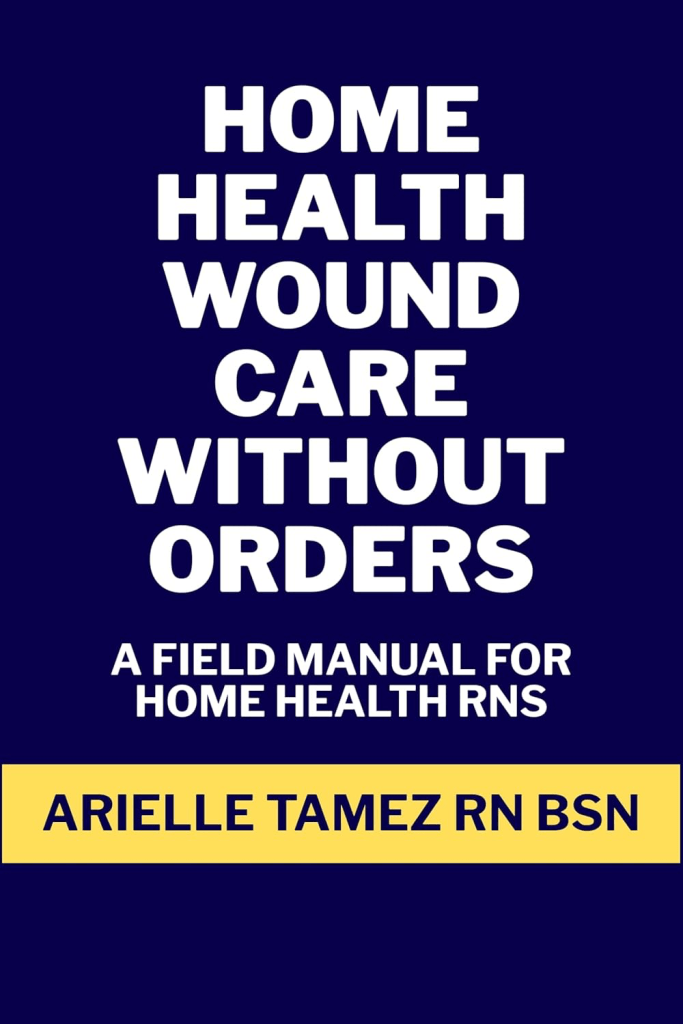
The book walks through:
- How to assess eschar safely
- What to protect versus escalate
- How to document defensibly
- How to advocate for appropriate next steps
- How to manage complex wounds and NPWT in the home
It’s written specifically for home health RNs, not hospital wound teams.
Bottom Line
Eschar is not just dead tissue — it’s a warning sign.
In home health:
- Stable eschar gets protected and monitored
- Unstable eschar gets escalated
Your job isn’t to remove eschar.
Your job is to recognize what it’s telling you and prevent the wrong intervention.
If you want a practical, step-by-step framework you can use visit to visit, the field manual is linked above.
 RNonWheels
Leave a comment